Example - Weighted Average with Uniform Weights
A weighted average has been set up with uniform weights:
- Appointed Time Score: 1.00
- Quality Score: 1.00
- Quantity Score: 1.00
- Return Score: 1.00
If all criteria weights are set to 1.00, the weighted average simplifies to a regular arithmetic mean.
Process Purchase Order and Receipt
Four items are purchased from a vendor for various quantities and promised receipt dates.
| Item | Quantity | Promised Receipt Date |
|---|---|---|
| Q-20003 | 100 | October 12 |
| Q-20004 | 80 | October 18 |
| Q-20005 | 50 | October 18 |
| Q-20006 | 10 | October 29 |
The order arrives with all items on October 18th, with some discrepancies: five and seven additional items were received of items Q-20003 and Q-20005, respectively, and Q-20006 had some extensive damage to the packaging.
| Item | Quantity | Promised Receipt Date | Arrival Date | Over-Receipt Quantity | Quality Rating |
|---|---|---|---|---|---|
| Q-20003 | 100 | October 12 | October 18 | 5 | F3 (product quality 100%) |
| Q-20004 | 80 | October 18 | October 18 | F3 (product quality 100%) | |
| Q-20005 | 50 | October 18 | October 18 | 7 | F3 (product quality 100%) |
| Q-20006 | 10 | October 29 | October 18 | F6 (packaging with serious defects 77%) |
Calculate Hard Criteria and Vendor Rating
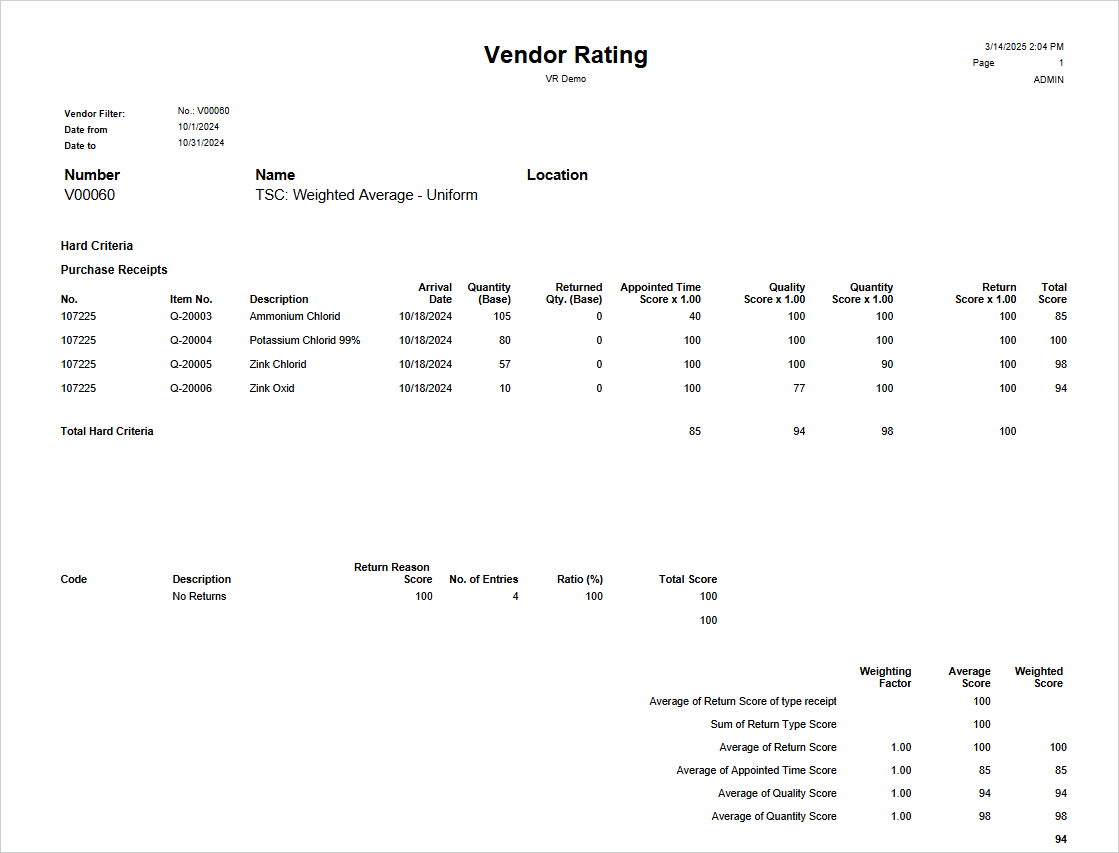
After the Calculate Vendor Rating and Vendor Rating batch jobs are run, the hard criteria are calculated and shown in the Vendor Rating report.
Total Score Calculation for Hard Criteria
The total scores of each hard criterion was calculated from the average of each hard criteria score for each item.
| Hard Criteria | Formula | Total Score |
|---|---|---|
| Appointed Time Score | (40+100+100+100) / 4 | 85 |
| Quality Score | (100+100+100+77) / 4 | 94 (rounded from 94.25) |
| Quantity Score | (100+100+90+100) / 4 | 98 (rounded from 97.50) |
| Return Score | (100+100+100+100) / 4 | 100 |
Total Score Calculation for Items
The total scores for each item is calculated from the average of each hard criteria score for each item.
| Item | Formula | Total Score |
|---|---|---|
| Q-20003 | (40+100+100+100) / 4 | 85 |
| Q-20004 | (100+100+100+100) / 4 | 100 |
| Q-20005 | (100+100+90+100) / 4 | 98 (rounded from 97.50) |
| Q-20006 | (100+77+100+100) / 4 | 94 (rounded from 94.25) |
Total Hard Criteria Score
The total hard criteria score is calculated from the average of all total scores:
(85+100+98+94) / 4 = 94 (rounded from 94.25)
Returns
Returns are included in the total score calculation of the hard criteria, as shown in the center of the Vendor Rating report. If no return is processed, then the Return Reason Score and Ratio % are 100; therefore, the Total Score is 100, which has no effect on the total score.
For more information, see Weighted Average with Return Score.
Total Rating with Soft Criteria
The Total Rating score is calculated for the combination of the Hard and Soft Criteria scores, based on the corresponding weighting factors defined for the vendor.
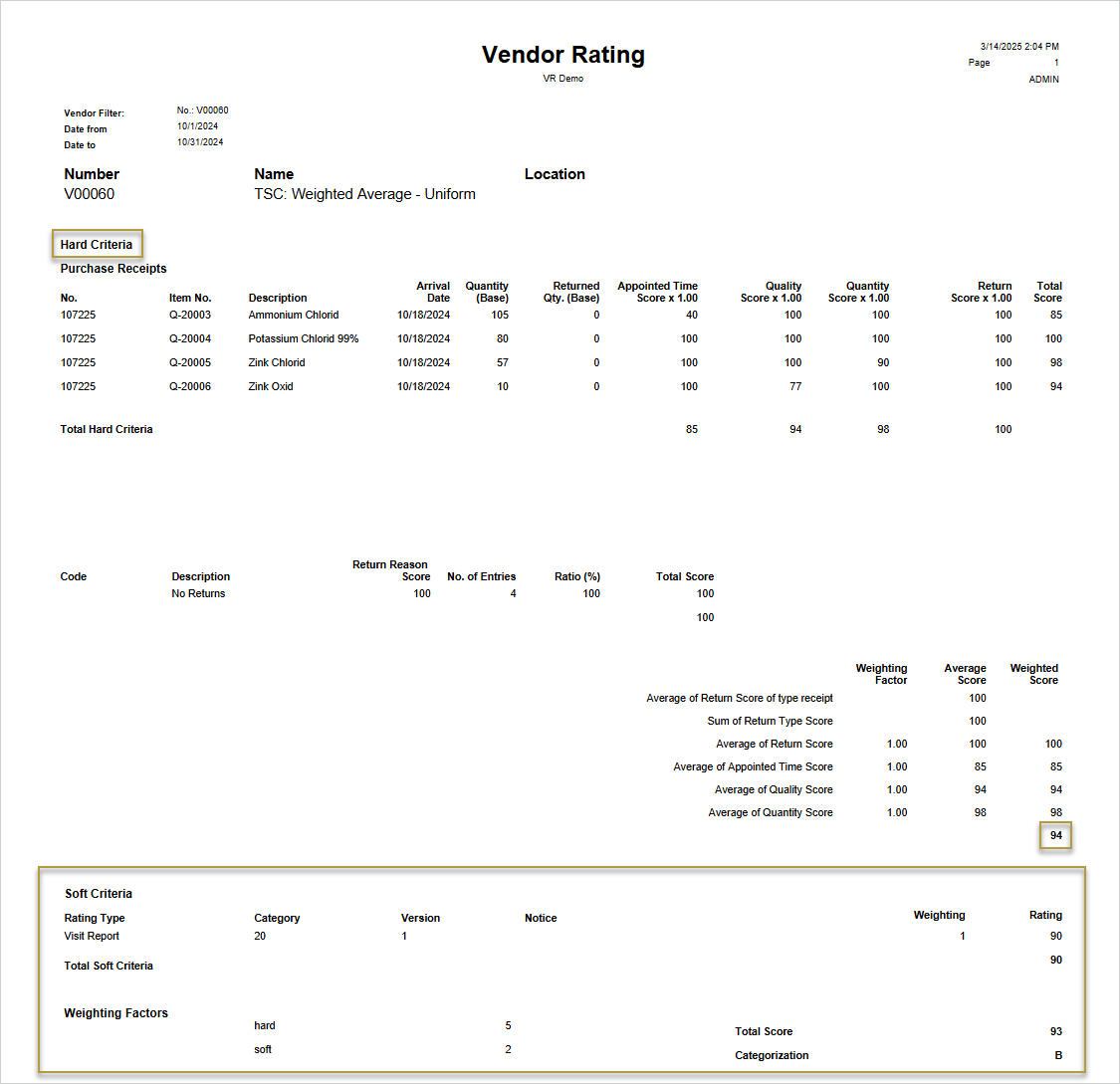
In this example, the hard criteria score of 94 and soft criteria score of 90 are multiplied by the weighting factor, averaged, and then summed to calculate the total rating:
| Criterion | Calculated Score | Weighting Factor | Formula | Weighted Score |
|---|---|---|---|---|
| Hard | 94 | 5 | (94*5) / 7 | 67 (rounded from 67.14) |
| Soft | 90 | 2 | (90*2) / 7 | 26 (rounded from 25.71) |
Therefore, the total vendor rating is calculated as 67+26 = 93. The Categorization is B due to the total score falling within the 70-94 range defined in the Categorization Codes.
If there is only a hard or soft criteria rating, then that criteria will be used as the total rating. For example, if no soft criteria was included, the total rating would be 67 and the Categorization would change to C.
Feedback
Submit feedback for this page .