Delivery Reliability
How reliably orders are delivered on time and in full - the ITIF perspective.
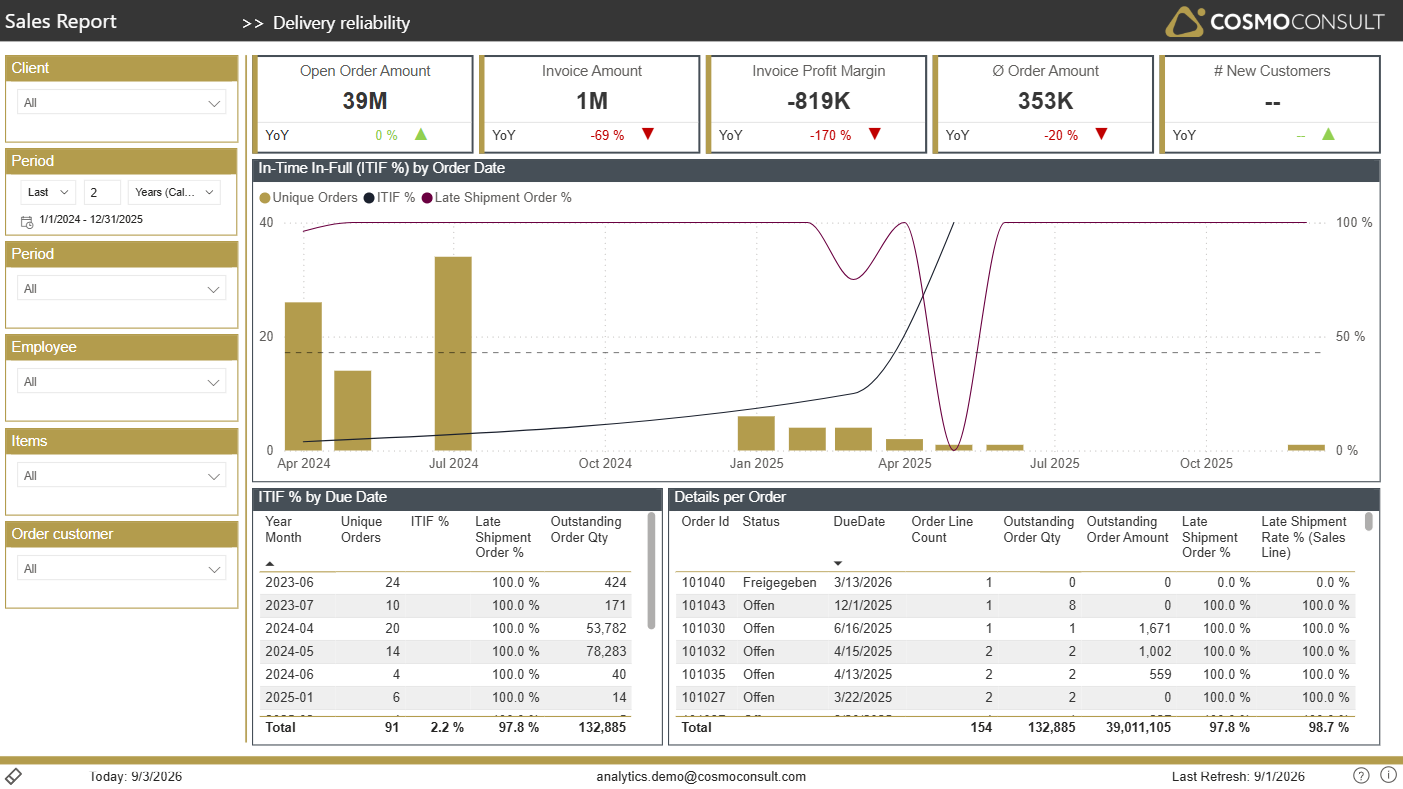
Turn shipment data into a clear delivery-performance picture. In-Time-In-Full (ITIF) and late-shipment rates, trended over time and broken down by order, show whether customers get what they ordered when promised.
At a glance
Generated from the report definition (Liefertermintreue / Delivery Reliability).
- Key visuals: line & column combo, 2× table
What this report helps you do
- Measure delivery performance with In-Time-In-Full (ITIF) and late-shipment rates
- Track how delivery reliability develops over time
- Quantify order lines and outstanding order value affected by late delivery
- Identify where delivery problems concentrate to target improvements
Filters & slicers
| Filter | What it does |
|---|---|
| Client, Period, Employee, Items, Order Customer | Focus reliability analysis on a company, period, salesperson, product portfolio or customer segment. |
Visuals on this page
Delivery Performance Trend
A combined line-and-column chart trends ITIF and late-shipment rates against order volume over time.
- Recognize seasonal or structural changes in delivery reliability
- Correlate delivery performance with order volume
- Detect deteriorating on-time delivery early
Delivery Detail Tables
Tables break down order lines, unique orders and outstanding order value with the associated reliability rates.
- See which orders or lines are delivered late
- Quantify outstanding order amount and quantity still to be shipped
- Prioritize expediting for high-value late orders
Typical use cases
- Operations & Fulfillment Review — Monitor delivery KPIs with operations to keep customer promises.
- Customer Service Protection — Detect declining reliability before it turns into customer complaints or churn.
Related KPIs
- ITIF %
- Late Shipment Order %
- Late Shipment Rate % (Sales Line)
- Order Line Count
- Outstanding Order Amount
See the full KPI & measure catalog for definitions and formats.
Back to all Sales standard reports · Semantic model · Key business questions