Customer Clustering
Segment customers by order frequency and value to set service levels.
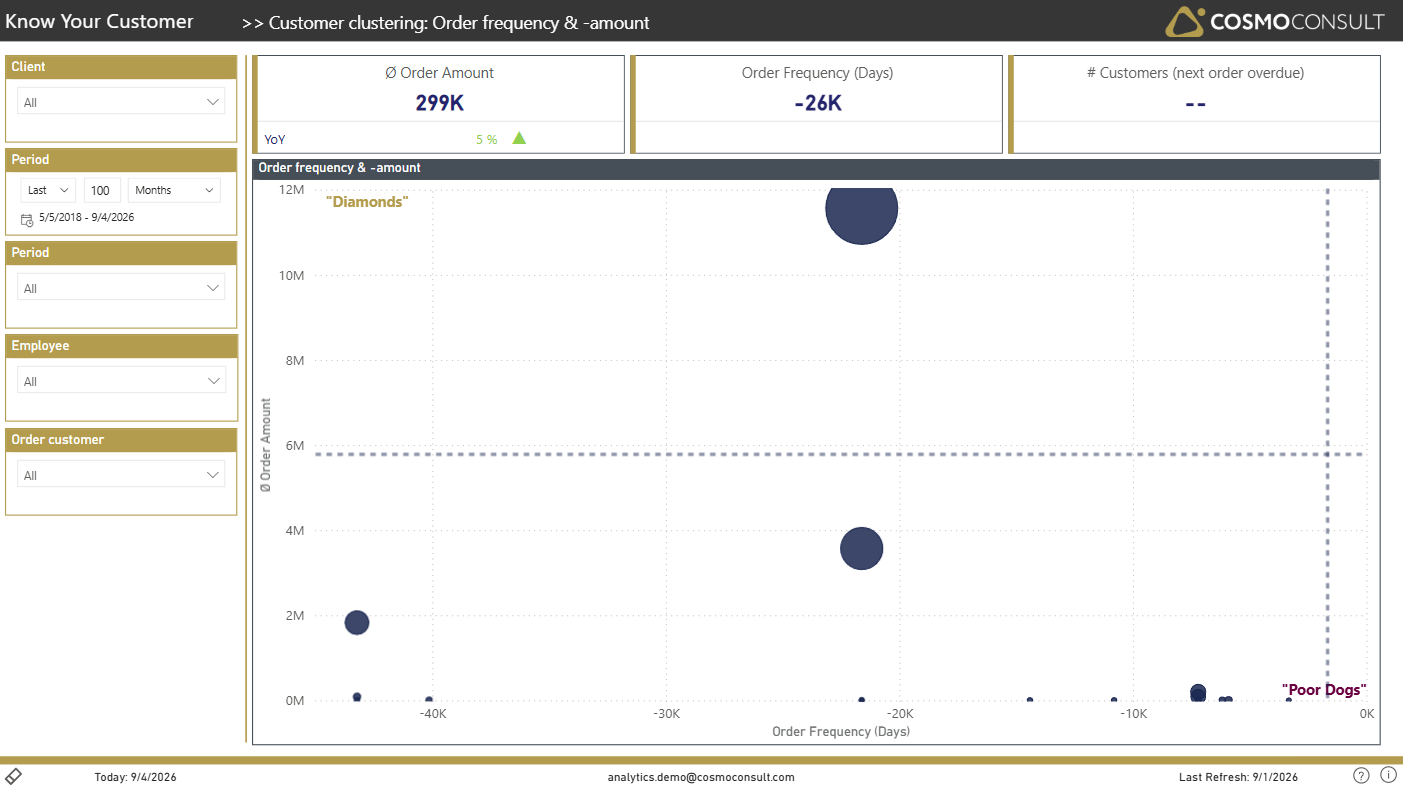
To strategically manage accounts it is essential to prioritise your available sales force in order to achieve the best possible results. Cluster customers by order frequency and monetary aspects, derive your "Diamonds" or "Poor Dogs", and set service levels accordingly.
At a glance
Generated from the report definition (Customer Clustering / Customer Clustering).
- Key visuals: scatter chart
- Drill-through by: Employee
What this report helps you do
- Segment customers by order frequency and monetary value
- Identify high-value "Diamond" accounts and low-value "Poor Dog" accounts
- Set differentiated service levels per customer segment
- Prioritise the sales force where it creates the most value
Filters & slicers
| Filter | What it does |
|---|---|
| Client, Period, Employee, Items | Focus the clustering on a company, period, salesperson or product portfolio. |
Visuals on this page
Frequency vs. Monetary Cluster
A scatter/matrix positions customers by order frequency and monetary value into segments.
- Read Diamonds (frequent, high-value) versus Poor Dogs (rare, low-value)
- Ø Order Frequency (Days) and Ø Order Amount drive the segmentation
- Assign service levels and account ownership per cluster
Typical use cases
- Service-Level Definition — Match sales effort and service intensity to each customer segment.
- Sales-Force Allocation — Concentrate scarce sales capacity on the highest-value clusters.
Related KPIs
- Ø Order Frequency (Days)
- Ø Order Amount
- Order Profit Margin
- # Customers Next Order Overdue
See the full KPI & measure catalog for definitions and formats.
Back to all Know Your Customer standard reports · Semantic model · Key business questions