Churn - Early Warning System
Get warned before a loyal customer silently churns.
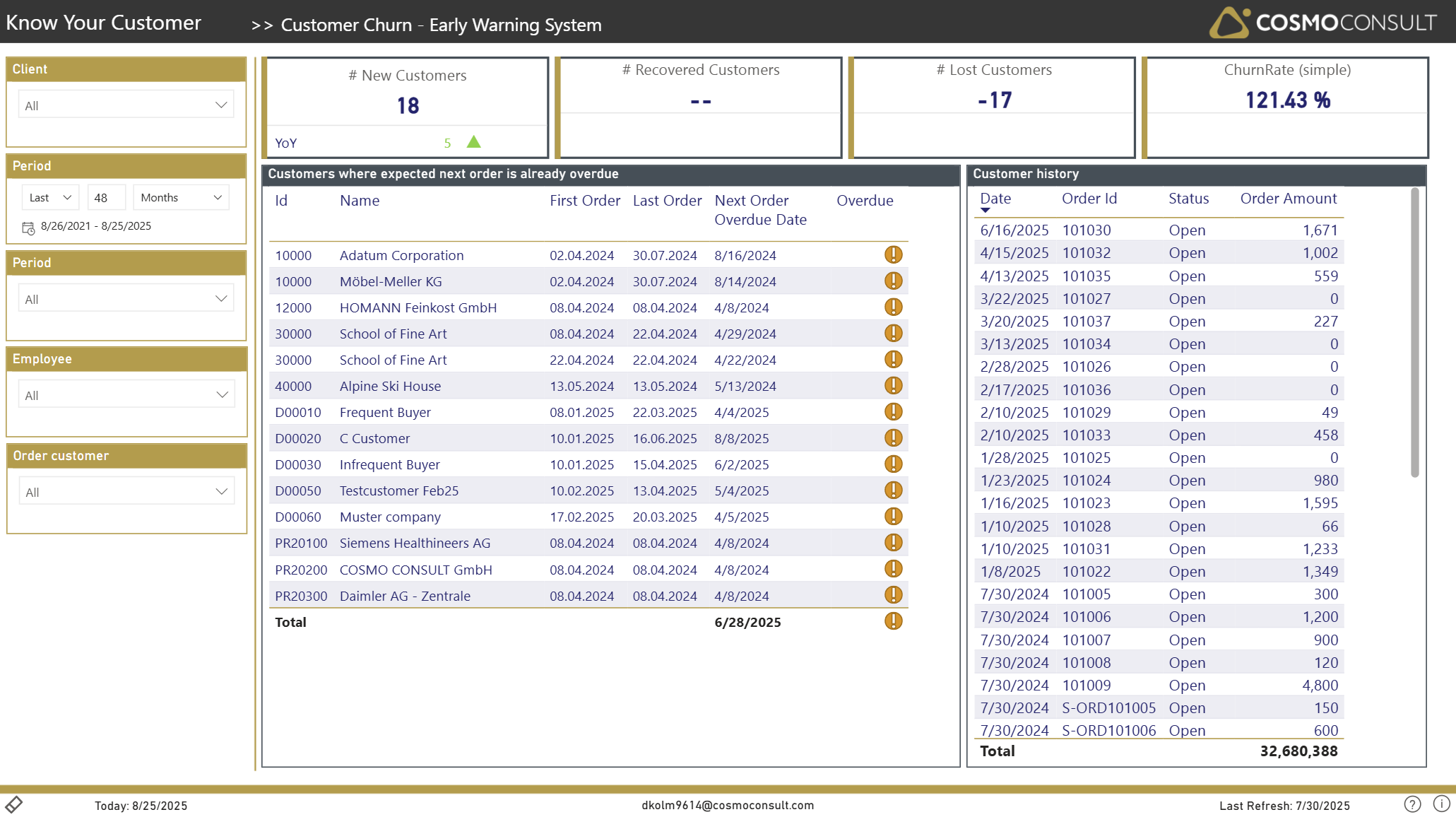
Monitoring the order frequency of your most loyal customers is essential. Imagine one of your top clients, who usually places an order every 4 weeks, keeps silent for 6 or even 8 weeks without you noticing - the probability of churn is already high, with the risk of losing a loyal customer. By monitoring the expected next order date and getting warnings when it is overdue, you never miss that point and can contact the customer or define other activities.
At a glance
Generated from the report definition (Customer Early Warning / Customer Early Warning).
- Key visuals: 2× table
- Drill-through by: Employee
What this report helps you do
- Monitor each customer's expected next order date
- Get warned when a loyal customer's next order becomes overdue
- Prioritise outreach to high-value customers at risk of churn
- Trigger proactive retention activities before a customer is lost
Filters & slicers
| Filter | What it does |
|---|---|
| Client, Period, Employee, Items | Focus the watchlist on a company, period, salesperson or product portfolio. |
Visuals on this page
Overdue Customers Watchlist
A list of customers whose next order is overdue, based on their typical order rhythm.
- # Customers Next Order Overdue quantifies the size of the risk
- Next Order Overdue Date shows how late each customer already is
- Sort by value to focus on the most important accounts first
Churn Context KPIs
Churn rate and lost/recovered customer counts frame the watchlist.
- Relate the overdue list to the overall churn rate
- See whether previously lost customers have recovered
Typical use cases
- Proactive Retention — Work the overdue watchlist daily and reach out before customers churn.
- Key Account Safeguarding — Ensure high-value loyal customers never slip through unnoticed.
Related KPIs
- # Customers Next Order Overdue
- Next Order Overdue Date
- ChurnRate (simple)
- # Lost Customers
- # Recovered Customers
See the full KPI & measure catalog for definitions and formats.
Back to all Know Your Customer standard reports · Semantic model · Key business questions