Scrap
Monitor scrap rate and scrap costs - a key margin driver - down to the operation level.
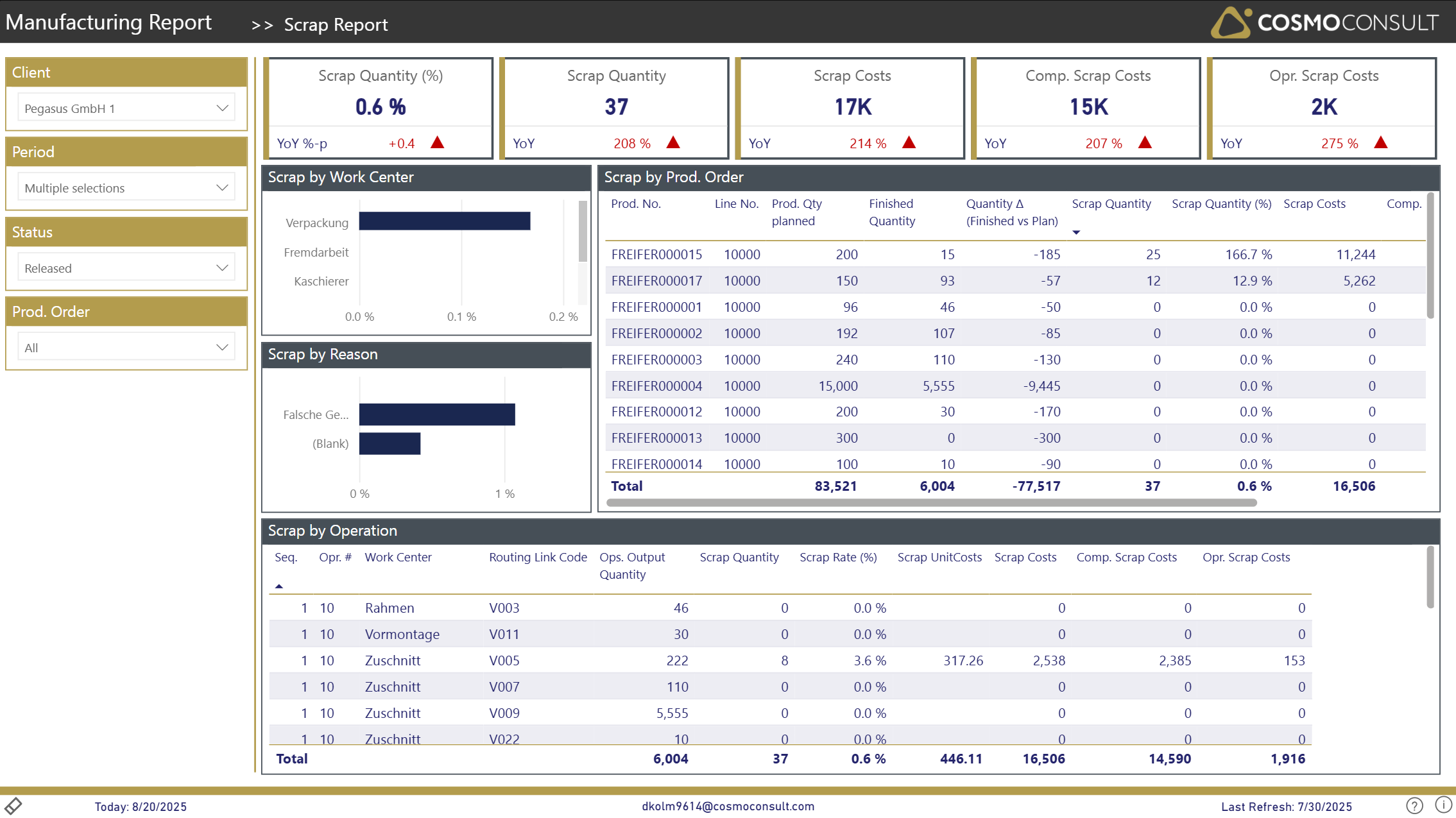
Monitoring scrap rate and scrap costs is essential, as high scrap increases production costs and thus lowers margins or forces higher sales prices, which may lead to competitive issues. Scrap costs are calculated on an operations level and result from two factors: component scrap costs (costs for discarded materials) and capacity scrap costs (costs for labor and/or machinery used to produce a certain product). Scrap unit costs increase by task, as each task adds value to the product. All details can be analyzed using interactive filtering to identify the main drivers.
At a glance
Generated from the report definition (Ausschuss / Ausschuss).
- Key visuals: 2× bar chart, 2× table
What this report helps you do
- Monitor scrap rate and scrap costs and their impact on margin
- Separate component scrap costs from capacity scrap costs
- Understand how scrap unit costs increase along the routing
- Identify the main scrap drivers by operation, work center, order and reason
Visuals on this page
Scrap by operation / work center / order
Scrap quantity and cost broken down for interactive analysis.
Scrap by reason
Scrap grouped by reason code to reveal the dominant causes.
Typical use cases
- Margin protection — Reduce the scrap that erodes production margins.
- Root-cause analysis — Drill into operations, work centers and reasons to find the main scrap drivers.
Related KPIs
- Scrap Rate (%)
- Scrap Costs
- Comp. Scrap Costs
- Opr. Scrap Costs
- Scrap UnitCosts
- Scrap Quantity
See the full KPI & measure catalog for definitions and formats.
Back to all Manufacturing (Discrete) standard reports · Semantic model · Key business questions