Summary
The COSMO Analytics Demand Planning report consists of multiple pages designed to provide comprehensive insights into demand, supply, and inventory management.
Report Structure
Standard Report pages are usually divided into five sections:
- Header (black area) - Report navigation and title
- Footer (white area at the bottom) - Last refresh date and other metadata
- Filter section on the left hand side - Interactive filters for data analysis
- KPI area on top of the visualization area - Key performance indicators
- Visualization core area - Charts, tables, and detailed analysis
Report Pages
1. Overview
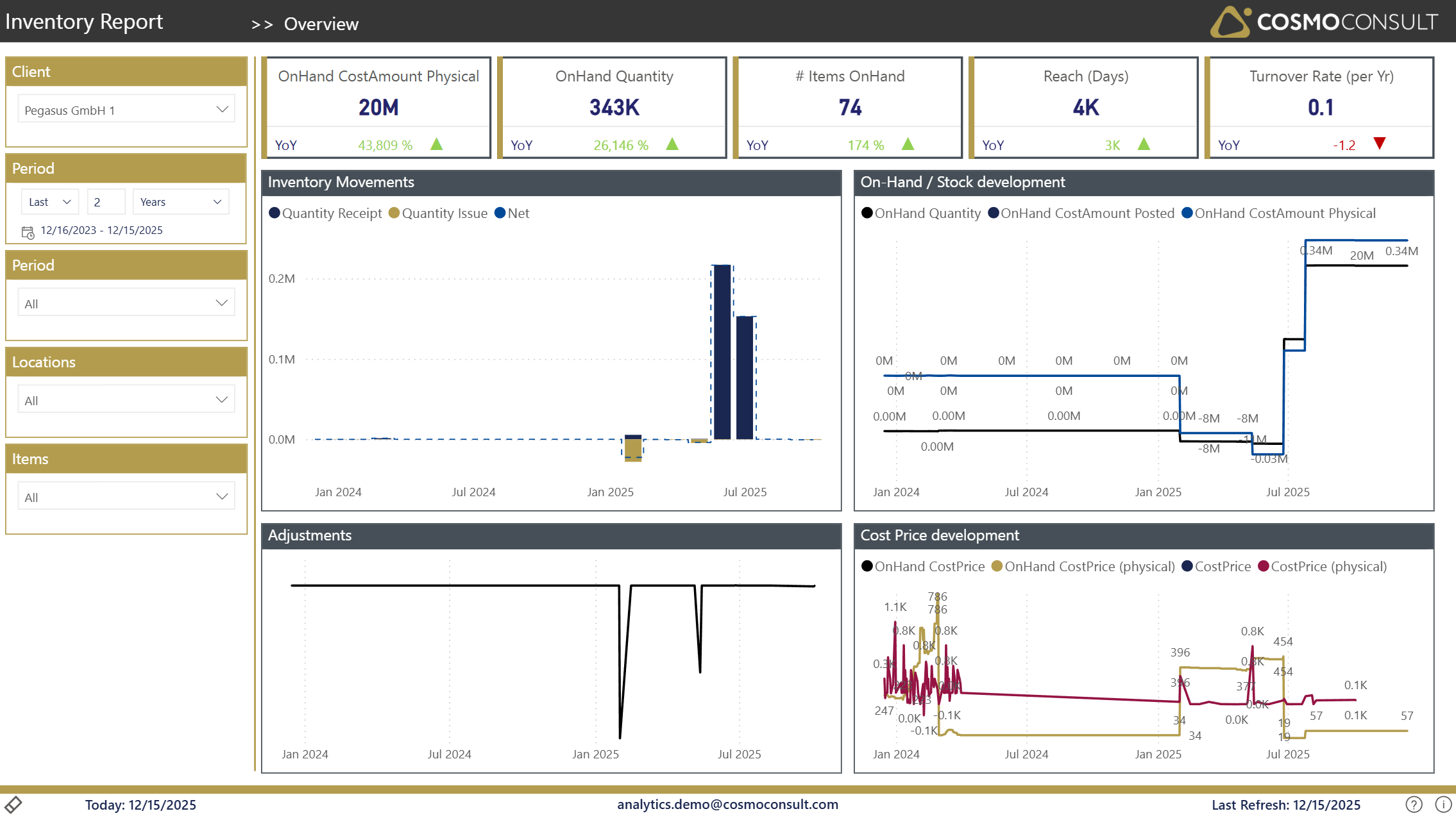
The Overview page provides a general summary of the most important KPIs as well as some high level trends:
- Inventory movements to identify long term trends in issued and receipt quantities
- On-Hand / Stock developments (Quantities & Valuation)
- Adjustments of your inventory value
- Cost Price development
2. By Location
Provides a location-centric view of inventory management, enabling analysis of stock levels, movements, and performance across different warehouse locations or distribution centers.
3. By Item
Offers an item-centric view with detailed analysis of stock levels, movements, and performance for each product in your portfolio, supporting product portfolio management and item performance optimization.
4. Item Analysis
Offers detailed insights about inventory movements and stock levels for specific items, enabling validation of ledger entries and analysis of statistical lead times for procurement processes.
5. Demand Outlook
Provides detailed insights into expected future inventory balance based on current stock, planned supply, and recorded demand. This page helps identify potential stock shortages or overstocks before they occur.
6. Master Data
Displays all current replenishment parameters for items and locations, providing easy access to maintain and validate SKU settings.
7. ABC/XYZ Classification
Helps categorize items based on demand significance (ABC) and demand stability (XYZ), enabling targeted strategies for inventory control and SKU parameter optimization.
8. Replenishment Optimization
Provides advanced analytics for optimizing inventory replenishment parameters based on historical demand patterns, lead times, and target service levels, with proposed safety stock and reorder point calculations.