Logistics Setup
The COSMO Logistics Setup page is used to configure basic logistics parameters such as application activation, number series, pool planning behavior, warehouse dimensions and SSCC labels. This configuration is typically performed once during implementation and is only changed by administrators or super users.
The Logistics Setup page is accessed using Tell Me. Choose the  icon, enter Logistics Setup, and then choose the related link.
Note
After installation and registration, the COSMO Logistics app is not automatically activated. This means that until activated, you will only find the Logistics Setup and License Overview pages when using the Tell Me feature.
General FastTab
| Field | Description |
|---|---|
| Activate Application Area | Makes pages and controls visible for COSMO Logistics (see App Activation). Turning off the toggle deactivates the app. This does not remove the app from the license; it only hides the COSMO Logistics functions and features. When deactivated, all fields on the page are disabled. |
| Copy Item Descr. to Warehouse Entries | Specifies whether the description from the item card is copied to warehouse entries during registration. |
Numbering FastTab
| Field | Description |
|---|---|
| Loading Nos. | Specifies the number series used when creating loading cards. |
Consignment Location FastTab
| Field | Description |
|---|---|
| Item Journal Template (Consignment Locations) | Specifies the default item journal template for consignment location processes. This template is used when creating item journals for consignment location activities. |
| Item Journal Batch (Consignment Locations) | Specifies the default item journal batch for consignment location processes. This batch is used when creating item journals for consignment location activities. |
Packing FastTab
| Field | Description |
|---|---|
| Enable Packing Comment | Determines whether packing comments can be entered during shipping unit creation. When enabled, users can add a packing comment that can be printed on related documents. |
Shipment Planning FastTab
| Field | Description |
|---|---|
| Auto Pick Nos. | Specifies the number series used for automatically created pick lines from the Warehouse Shipment List. |
| Automatic Recalculation of Item Availability | Specifies whether item availability is automatically recalculated when item journals are posted or warehouse activities are registered. |
| Type Whse. Shpt. Availability Warning | Determines the type of availability warning shown on the Warehouse Shipment Line. The options are: - Partial Quantity: A warning appears when no partial stock is available. - Total Quantity: A warning appears when the complete quantity cannot be delivered. |
| Priority No. Default Value | Specifies the priority number used for shipments that are not in a priority sequence. Lower numbers mean higher priority. |
| Shipment Priority per Location | Determines whether shipment priority uses each location's strategy. When disabled, the strategy in Shipment Priority Strategy applies to all locations. When enabled, locations without a strategy are not prioritized. |
| Shipment Priority Strategy | Specifies the strategy used for all locations when Shipment Priority per Location is disabled. |
| Shipment Priority Line Date | Determines how the Shipment Date, Planned Shipment Date, and Due Date criteria combine different dates on shipment lines. Minimum uses the earliest date; Maximum uses the latest. Lines without a date are ignored. |
Shipment Priority Strategies
Use Tell Me to open Shipment Priority Strategies - Logistics, then create a strategy and add its criteria in evaluation order. The first criterion has the greatest influence; subsequent criteria are used to order shipments with equal values. Use Move Up and Move Down on the strategy lines to change the order. Changes to a strategy or its assignment can prompt you to recalculate existing sequences.
| Criterion | How it orders shipments |
|---|---|
| Planned Shipment Date | Earlier dates first. Uses the source line's planned shipment date when available; otherwise, it uses the warehouse shipment line's shipment date. |
| Shipment Date | Earlier dates first. When lines have different dates, uses the Shipment Priority Line Date setting above. |
| Due Date | Earlier dates first. When lines have different dates, uses the Shipment Priority Line Date setting above. |
| Customer/Vendor Priority | Uses the Shipment Priority value on the destination customer or vendor. Lower positive values come first; zero is treated as no priority and comes last. |
| No Whse. Pick | Shipments without a warehouse pick come first. |
| Whse. Pick Exists | Shipments with a warehouse pick come first. |
| Whse. Pick for All Lines | Shipments with picks for all lines come first. |
| Registered Pick Exists | Shipments with a registered pick come first. |
| All Lines Picked | Shipments with all lines picked come first. |
When Shipment Priority per Location is enabled, assign a strategy on each Location Card. A location can have its own sequence or share a sequence with other locations that use the same strategy. See Location Setup. In this mode, strategies with pick-related criteria can only be assigned to locations where Require Pick is enabled. This setting does not control priority inheritance to created warehouse picks; see Shipment Priority.
Note
The Show Details on Sequence Planning Page setting is retained for the pending-obsolete standalone page. It does not control the advanced view of the Warehouse Shipment List. See Legacy Shipment Detail Settings.
Pre-Pick FastTab
| Field | Description |
|---|---|
| Warehouse Journal Template (Pre Picking) | Specifies the default warehouse journal template for pre-pick processes. Only warehouse journal templates of type Reclassification can be selected. |
Warehouse Request Lines FastTab
| Field | Description |
|---|---|
| Due Date Filtering on Outb. Whse. Req. Page | Specifies how outbound warehouse request lines are filtered based on the due date. The filter uses a date formula calculated from the work date. |
SSCC Label FastTab
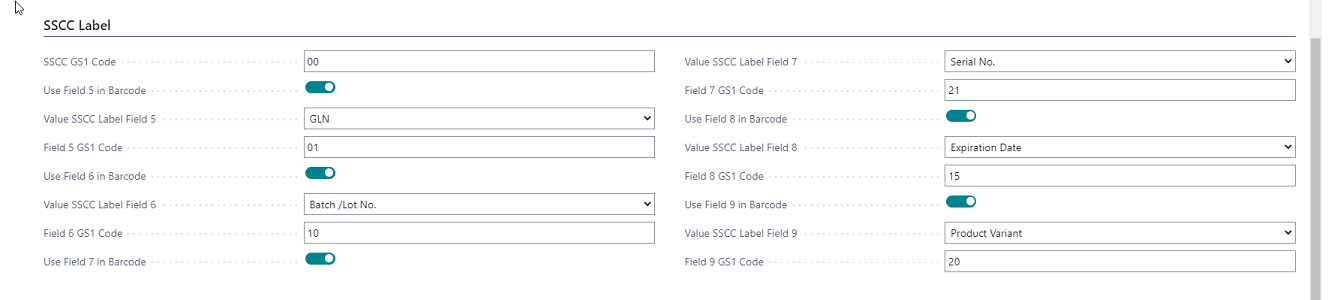
A Serial Shipping Container Code (SSCC) label can be generated from the Logistics Pick document. Some of the components of the SSCC label are fixed, but you can configure five additional fields for the SSCC label.
| Field | Description |
|---|---|
| SSCC GS1 Code | Specifies the GS1 application identifier for SSCC. The required GS1 AI code for SSCC is 00. |
| Use Field 5 in Barcode | Determines whether the value selected for field 5 is included in the SSCC barcode. |
| Value SSCC Label Field 5 | Specifies the value that is printed on SSCC label field 5. |
| Field 5 GS1 Code | Specifies the GS1 code used for printing and barcode generation of SSCC label field 5. |
| Use Field 6 in Barcode | Determines whether the value selected for field 6 is included in the SSCC barcode. |
| Value SSCC Label Field 6 | Specifies the value that is printed on SSCC label field 6. |
| Field 6 GS1 Code | Specifies the GS1 code used for printing and barcode generation of SSCC label field 6. |
| Use Field 7 in Barcode | Determines whether the value selected for field 7 is included in the SSCC barcode. |
| Value SSCC Label Field 7 | Specifies the value that is printed on SSCC label field 7. |
| Field 7 GS1 Code | Specifies the GS1 code used for printing and barcode generation of SSCC label field 7. |
| Use Field 8 in Barcode | Determines whether the value selected for field 8 is included in the SSCC barcode. |
| Value SSCC Label Field 8 | Specifies the value that is printed on SSCC label field 8. |
| Field 8 GS1 Code | Specifies the GS1 code used for printing and barcode generation of SSCC label field 8. |
| Use Field 9 in Barcode | Determines whether the value selected for field 9 is included in the SSCC barcode. |
| Value SSCC Label Field 9 | Specifies the value that is printed on SSCC label field 9. |
| Field 9 GS1 Code | Specifies the GS1 code used for printing and barcode generation of SSCC label field 9. |
Below is a sample SSCC label showing the positions of configurable fields 5–9.
Text Module FastTab
Important
In Logistics 27.0, Logistics-specific Text Set ID fields and related page controls are pending obsolete. They remain in the current release and their existing behavior is unchanged, but are planned for removal. The setup options below remain available. See Text Set ID deprecation and the COSMO Text Module documentation for details.
| Field | Description |
|---|---|
| Text Module Logistics Integration Activated | Determines whether the COSMO Text Module integration is activated. By default, this is not activated because it requires a separate license. This option is automatically set when the Predefined Text Module Setup action for Logistics is run (Related menu > Setup). If the Text Module setup is done manually, this toggle must also be activated manually. When disabled, Text Module references are hidden in warehouse-related pages. For more information, see COSMO Text Module. |
| Show Additional Text on Activity Type | Controls how additional text is printed on warehouse activity documents. The options are: - Place: Prints additional text only on place lines. - Take: Prints additional text only on take lines. - Take & Place: Prints additional text on both take and place lines. |
Tour FastTab
| Field | Description |
|---|---|
| Tour Nos. | Specifies the number series used for tours. |
| Deletion of Tours with Lines | Determines whether tours containing lines can be deleted directly. When disabled, the tour can only be deleted after its lines are removed or reassigned. When enabled, the tour can be deleted after confirmation even if lines exist. |
Whse. Dimensions FastTab
Warehouse Dimensions can be defined at item level. On source document level (for example sales order, purchase order), item warehouse dimensions are added to the source line. From the source line, the warehouse dimensions are transferred to Warehouse Request Lines, posted Warehouse Receipt/Shipment Lines, Logistics Activity Lines, Tour Lines and Warehouse Entries. This page defines which dimensions can be used in Logistics.
| Field | Description |
|---|---|
| Global Whse. Dim. 1 - 15 Code | Specifies up to 15 code-based warehouse dimensions. |
| Global Whse. Dim. 1 - 5 Code D | Specifies up to 5 decimal-based warehouse dimensions. |
| Length Whse. Dim. Code | Specifies the warehouse dimension code used to capture length. This value is synchronized to the base item unit of measure length field. |
| Width Whse. Dim. Code | Specifies the warehouse dimension code used to capture width. This value is synchronized to the base item unit of measure width field. |
| Height Whse. Dim. Code | Specifies the warehouse dimension code used to capture height. This value is synchronized to the base item unit of measure height field. |
App Licensing FastTab
| Field | Description |
|---|---|
| App License Valid Until | Specifies the date and time until the license is valid. |
| App License Status | Specifies the status of the license. |
| App License Information | Displays information regarding your license from the licensing server. |
| App Granule Disabled | Indicates whether the app granule has been disabled on the COSMO License Overview page (see App Licensing and Registration). |
Feedback
Submit feedback for this page .